Technology, Geopolitics and the Future of Investing
Artificial intelligence is reshaping industries; geopolitical tensions are influencing global supply chains, and proposed tax reforms are prompting investors to rethink long-term wealth strategies. Yet amid the constant flow of headlines and market noise, one theme emerged throughout the Investor Outlook Masterclass: successful investing is less about predicting what comes next and more about building portfolios that can adapt to changing market conditions. For today's investors, that means focusing on the factors they can control portfolio construction, diversification, investment quality, and long-term discipline.
Building Portfolios for an Uncertain World
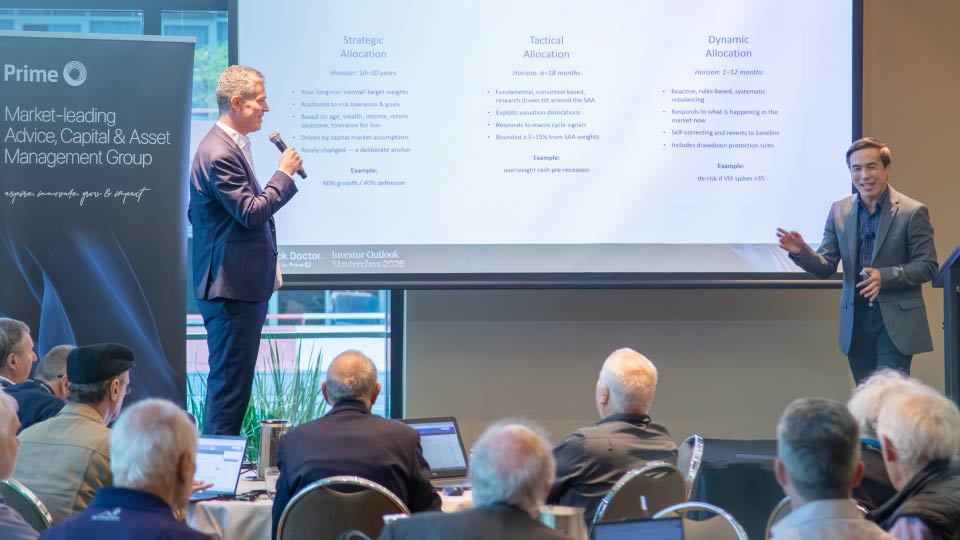
Much of the time investors spend managing their portfolios is devoted to researching individual companies. Yet portfolio construction often receives far less attention. This is despite decades of research highlighting the importance of asset allocation in driving long-term investment outcomes.
In a world shaped by constant market noise and competing investment narratives, it is easy to lose sight of what matters most. Long-term investment outcomes are often less dependent on forecasting the next market winner and more influenced by disciplined asset allocation, diversification, and a portfolio designed to withstand changing market conditions.
The benefits of diversification have long been recognised by investors. As Nobel Prize-winning economist Harry Markowitz famously observed, "Diversification is the only free lunch in investing." However, effective diversification is not simply about increasing the number of holdings in a portfolio; it is about combining assets that are likely to perform differently across a range of economic and market conditions.
Australian equities represent less than 2% of global share market capitalisation, yet many self-directed investors allocate a significant portion of their portfolios domestically. While familiar, this can create substantial concentration risk, particularly to financials and resources, while limiting exposure to many of the world's largest technology, healthcare and consumer businesses.
The broader message was simple: strong portfolios are built deliberately. Investors who understand where their risks lie and how their assets work together are often better prepared when markets become unpredictable.
Finding Value Beyond the Numbers
While investment success is often associated with finding undervalued companies, a key theme explored during the Investor Outlook Masterclass was that some of the strongest long-term performers have been businesses demonstrating improving earnings, high returns on capital and strong cash generation, rather than simply trading on low valuation multiples.
Equally important is earnings quality. Two companies may report similar profits, but businesses supported by strong operating cash flow, expanding margins and disciplined capital allocation are generally better positioned to sustain growth over time.
The conversation also explored momentum investing, a factor that continues to challenge traditional investment theory. Nobel Laureate Eugene Fama famously described momentum as "the biggest embarrassment to efficient market theory" because of its persistence across markets.
These observations challenge a common misconception about value investing. A low valuation multiple does not automatically represent value; in many cases, it reflects declining fundamentals or weaker earnings expectations.
Ultimately, investors may be better served by looking beyond headline valuation of metrics and focusing on businesses that can consistently create value over time.
Rather than exiting a position simply because a share price has risen or a valuation appears stretched, investors should reassess whether the original investment thesis remains intact. Deteriorating earnings quality, weakening financial health, repeated earnings downgrades or an erosion of competitive advantage are often stronger reasons to sell than short-term price movements alone.
The Growing Influence of Geopolitics
For decades, geopolitical events were often viewed as temporary market disruptions. Today's environment looks very different. Trade policy, energy security, technological competition and shifting alliances are increasingly shaping inflation, economic growth, and corporate profitability. Decisions made in Washington, Beijing, and Brussels can influence global supply chains, redirect capital flows, and transform entire industries.
Michael Feller, Co-Founder and Chief Strategist at Geopolitical Strategy, argued that investors must recognise this structural shift. "Geopolitics has moved from being a peripheral market risk to a central investment consideration." Importantly, the takeaway was not that investors should reposition portfolios around every political headline. Rather, understanding the long-term geopolitical trends shaping industries is becoming just as important as analysing company earnings and balance sheets.
Where Innovation Meets Investment Discipline
Artificial intelligence may prove to be one of the defining technological developments of this decade. The bigger challenge for investors, however, is determining which companies can translate that opportunity into sustainable earnings growth. Paul Mason, Managing Director of Technology at Evans and Partners, encouraged investors to remain focused on fundamentals: "Understand the product. Understand the customer. Understand market opportunities. Ignore the hype."
While AI is creating significant opportunities, investors were reminded that technological innovation alone does not guarantee investment success. History is full of transformative technologies that changed industries but failed to deliver superior shareholder returns. Long-term winners typically combine innovation with durable competitive advantages, disciplined execution, and an ability to consistently grow earnings.
The Importance of Investment Structure
Building wealth is not solely about selecting the right investments. The structure used to hold those investments also plays an important role in determining long-term outcomes. With ongoing discussions around capital gains tax, discretionary trusts and negative gearing, investors are increasingly focusing on after-tax returns rather than simply pre-tax performance.
Marcus Ainger, Wealth Partner at Prime Financial Group, highlighted the importance of considering structure alongside investment selection. "Investment returns matter, but the structure used to hold investments may become increasingly important as tax rules evolve." As portfolios grow, reviewing ownership structures can become just as important as reviewing the investments themselves.
Looking Ahead
No one can say with certainty what the next few years will bring. Markets will continue to respond to new technologies, shifting geopolitical relationships, and changing policy settings.
What investors can control, however, is how they prepare.
Throughout the Masterclass, the strongest message wasn't about predicting the next market winner or forecasting the next crisis. It was about building portfolios that can withstand uncertainty and adapt as conditions change.
That means focusing on diversification, owning quality businesses, maintaining appropriate asset allocation, and staying disciplined when markets inevitably become volatile.
The headlines will change. The principles of successful investing are rarely done.